The meaning of poverty in Benedictine monastic life
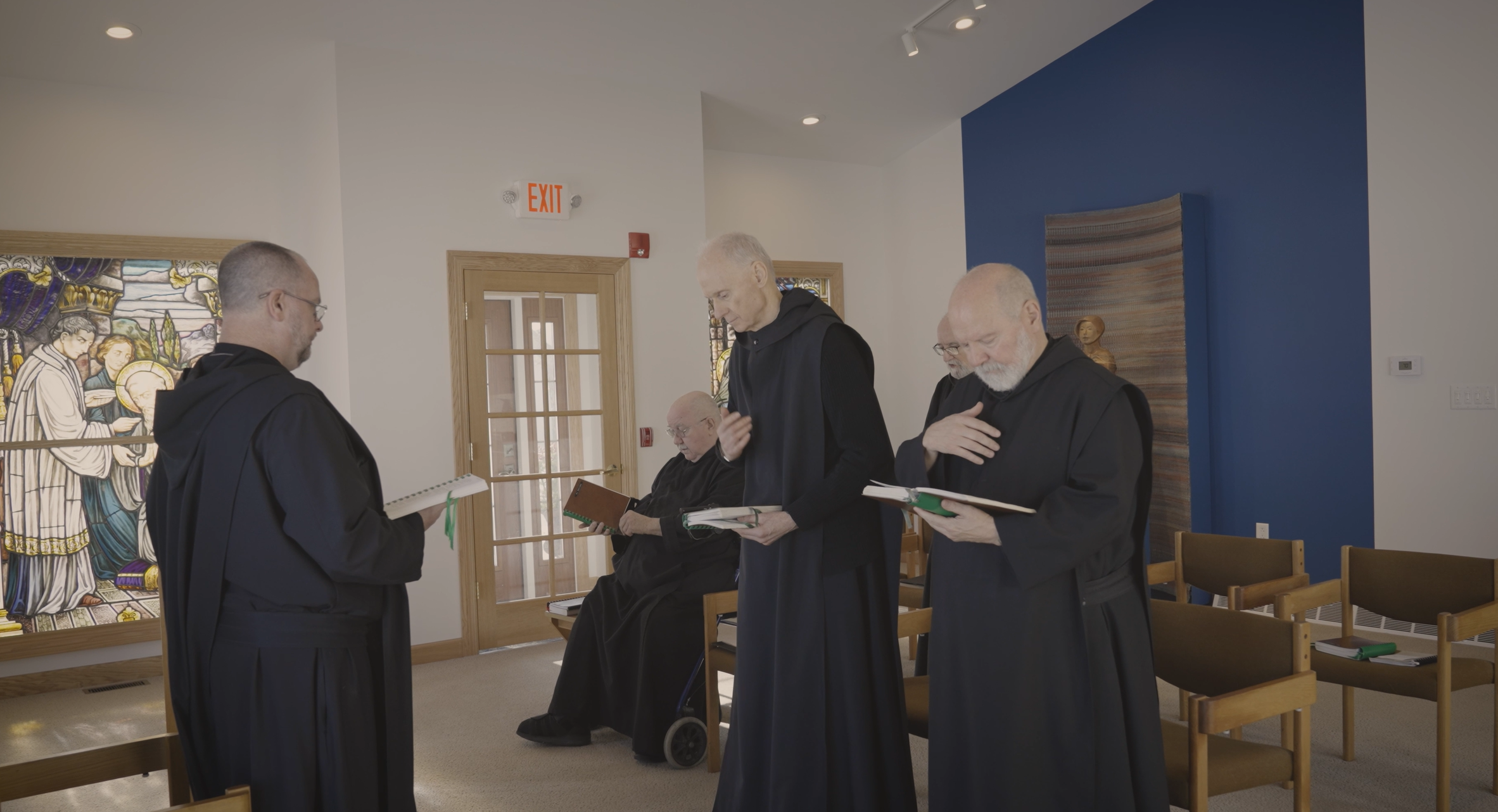
The monks gathering for mid-day prayer.
You may be familiar with the commonly promised religious vows: poverty, chastity and obedience. But as you explore how to become a monk, you’ll note that the Benedictine vows are notably different: stability, obedience and conversatio morum.
You can learn more about the Benedictine vows here.
That’s not to say that poverty isn’t part of the Benedictine monastic practice. Or even missing from the vows at all. Poverty is central to monastic life, informing the communal rule inside our monastery in Illinois, as well as shaping the spiritual practice of the monks.
That third vow, conversatio morum, in fact acknowledges poverty. It refers to an ongoing process of spiritual growth and personal transformation. In essence, a Benedictine monk strives to find God in the ordinary. That includes renouncing worldly attachments as a means of radical reorientation toward the values of the Gospel. To get closer to God, a monk commits to living simply, detached from material goods and comforts.
You can learn more about conversatio morum here.
That creates a process that informs a monk’s spiritual journey, every single day.
Understanding the spiritual transformation of poverty
Some might see the word poverty and immediately think of a restrictive practice of self-denial. As with many Benedictine values, however, poverty is reframed, encouraging monks to free themselves. Poverty is about detachment—from possessions as well as material needs. In monastic life, there is no status signaling or personal accumulation.
Benedictine poverty trains a monk to not think of things as “mine” and instead trust in the community. It’s a dependance on God, mediated through others. And it’s a slow reorientation from possession to presence.
Similarly, it’s key to recognize that poverty isn’t meant to be a spiritual flex. Just as a monk is not meant to boast over having more, they also should not boast over having less.
You can learn more about Benedictine monks’ prayer and spiritual life here.
Possessions serve the work of God
In The Rule, St. Benedict writes: “Let all things be common to all… and let no one presume to give or receive anything without the abbot’s permission.”
You can learn more about The Rule—and how it informs life at our monastery in Illinois—here.
He even mentions items that may seem trivial, like pens, knives and clothing. The object itself doesn’t matter. What’s key is that monks cultivate an internal posture away from possessions of any kind.
Through private ownership, one may breed comparison, attachment, and quiet competition. These are all attitudes that can be damaging to communal life.
Of course, a monk certainly uses many items. Clothes, books and tools are all necessary inside the monastery. And even modern monks may use a laptop.
But it’s important to understand that he does not own these items. They belong to the monastery. In fact, personal items are assigned to an individual monk rather than chosen by them.
So at our monastery in Illinois, clothing is issued from St. Bede’s common wardrobe. Books are borrowed rather than kept in a personal library. Only designated monks handle money at a given time. As for gifts, a monk is to make the abbot aware of anything received from a family member. Any monetary gifts are deposited in the community’s day-to-day budget.
For Benedictine monks, possessions serve the work of God. Tools serve labor, just as books serve monks’ prayer and study. And food serves the purposes of providing the strength to continue working. If an object doesn’t serve communal life, it doesn’t belong in the monastery.
What we can all learn from Benedictine poverty
Even in the 6th century, St. Benedict recognized the restrictions that possessions put on our spirituality. And throughout history, it’s a theme we’ve seen again and again. But in today’s world—obsessed with optimization and upgrades—this philosophy takes on even deeper meaning.
You can explore more about Benedictine teachings as they apply to life outside the monastery here.
Benedictine poverty shows us that you are not what you own or curate. Rather, you are what you give yourself to, every day.
As you continue to discern your path—asking “how do I become a monk”—this is a transition to which you are invited. If you’re ready to take the next step and learn more about how to become a monk, you can get in touch with us by submitting the form at this link.